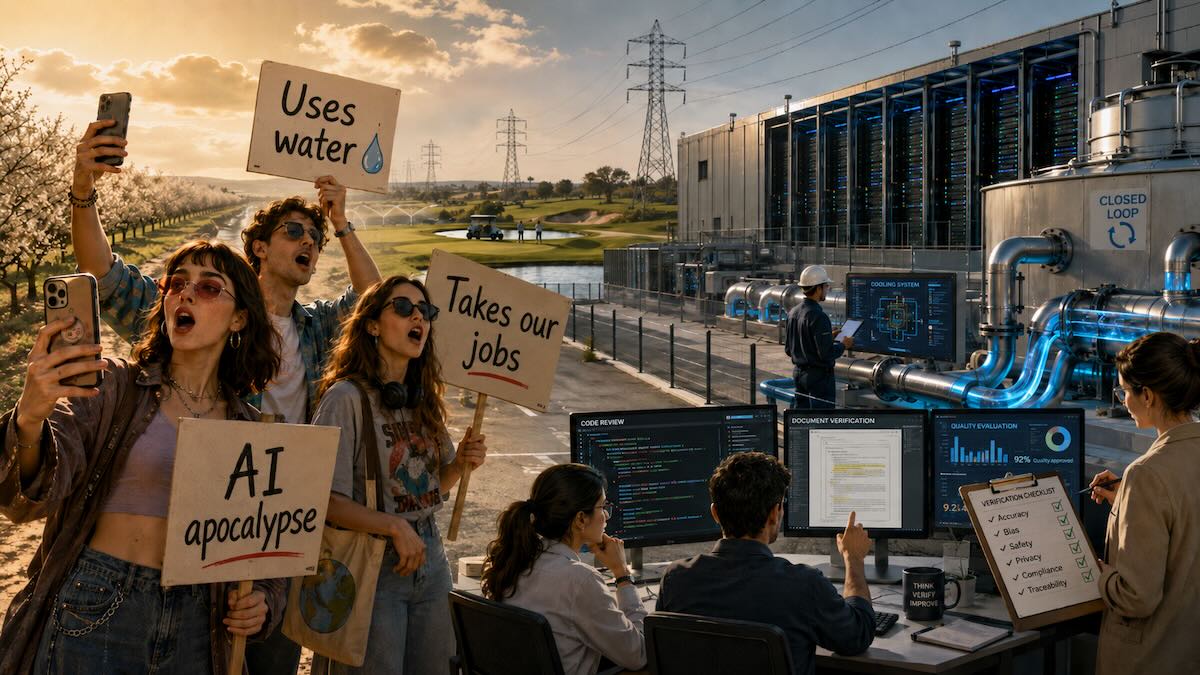
The anti-AI crowd is not wrong to ask questions about water, electricity, jobs, copyright, concentration of power and governance.
Those are real issues.
What is embarrassing is how many people are building their entire anti-AI identity on outdated claims, bad comparisons and recycled moral panic.
They do not compare AI to the real world.
They compare AI to an imaginary zero-cost universe where no other industry consumes water, electricity, land, minerals, labor or attention.
Take water.

One of the laziest anti-AI arguments is: “AI uses water, therefore AI is uniquely evil.”
Okay. Compared to what?
Agriculture uses water. Restaurants use water. Almonds use water. Beef uses water. Golf courses use water. Lawns use water. Semiconductor fabs use water. Factories use water. Hotels use water. Coffee uses water. The entire physical economy uses water.
The serious question is not: “Does AI consume resources?”
The serious question is: “What is the value produced per unit of resource consumed, and how fast is the infrastructure improving?”
That is where the anti-AI argument usually falls apart.
Satya Nadella recently said Microsoft’s newer AI data center cooling design can use annual water comparable to a single restaurant, because the cooling loop is filled once and recirculated.
Does that mean every data center is perfect? No.
Does it mean water concerns are fake? No.
But it absolutely destroys the brain-dead claim that AI is permanently destined to “drink towns dry” as if cooling technology, siting, recirculation and infrastructure design are frozen in 2023 forever.
Same with electricity.
Yes, AI data centers use a lot of power.
Yes, the demand curve is real.
Yes, grids need upgrades.
But “this uses electricity” is not an argument against a civilization-level technology.
It is an argument for building more generation, better transmission, more storage, better cooling, smarter workload scheduling, more nuclear, more geothermal, better demand response and better grid planning.
The anti-AI crowd keeps treating infrastructure constraints as moral proof that the technology should not exist.
That is childish.
Civilization is infrastructure.
If a technology is useful enough, you do not ban it because substations are hard.
You build the substations.
Then there is the heat argument, which might be the stupidest one.
People compare data center heat to bombs, weapons and apocalyptic energy releases because it sounds scary.
But that is not physics. That is propaganda.
A bomb releases energy almost instantly.
A data center dissipates heat continuously through cooling systems, buildings, air, land and grid infrastructure.
Same “big number” energy comparisons can sound terrifying when you strip away time, density, context and physical mechanism.
A 16 GW load is a serious industrial planning problem.
It is not a thermonuclear event.
And again, nobody applies this standard consistently.
Nobody says, “Shut down Texas because the grid dissipates a massive amount of heat every day.”
Nobody says, “Streaming video is immoral because server farms exist.”
Nobody says, “Ban luxury agriculture because premium crops use water.”
But AI gets judged against perfection because people have decided they hate the aesthetic, the companies, the founders, the investors or the feeling that the ground is moving under their career.
Which brings us to jobs.
The dumb anti-AI take is:
“AI automates work, therefore everyone is about to be unemployed.”
The reality is more interesting.
AI is not currently eliminating work as cleanly as people imagined.
It is mutating work.
It collapses the cost of generating outputs, but it does not automatically collapse the cost of trusting those outputs.
That is the key.
AI can create 100 drafts, 100 code changes, 100 images, 100 reports, 100 legal arguments, 100 customer replies, 100 marketing concepts, 100 research summaries.
Great.
Now who verifies them?
Who checks the facts?
Who catches the hallucination?
Who makes sure the code does not break production?
Who checks compliance?
Who decides which output is actually useful?
Who signs their name to it?
That is why automation often creates a backlog of human judgment before it eliminates labor.
The bottleneck used to be production.
Now the bottleneck is verification.
This is what the simplistic “AI takes jobs” crowd keeps missing.
In the near term, AI often increases the volume of work that organizations can generate faster than they can absorb, review, route, approve, integrate or trust.
So instead of “everyone gets replaced overnight,” you get a new layer of work:
AI workflow designers.
Reviewers.
Editors.
Model evaluators.
Compliance people.
Data curators.
QA testers.
Domain experts.
Security auditors.
Knowledge-base architects.
Escalation managers.
People who can tell the difference between a good answer and a polished hallucination.
That does not mean displacement is fake.
It means displacement is not a light switch.
It is a phase transition.
Phase one: AI helps humans produce more.
Phase two: humans spend more time reviewing, supervising and integrating AI-generated work.
Phase three: AI systems become reliable enough that humans review exceptions, audits and edge cases.
Phase four: in some domains, whole layers of routine knowledge work probably disappear.
That is the real debate.
Not “AI is useless slop.”
Not “everyone is unemployed tomorrow.”
The real debate is: how quickly does verification itself get automated?
Because as long as trust remains expensive, humans remain in the loop.
Once AI becomes good enough to not only generate work but verify, audit, test, cite, simulate, compare, comply and self-correct at a high level, then yes, the labor market changes much more violently.
But we are not there across the economy yet.
The latest U.S. jobs data made this obvious. Employers added far more jobs than expected in May, and unemployment stayed basically steady.
That does not prove AI creates jobs forever.
But it does make the cartoon apocalypse look stupid.
If AI were already causing immediate broad labor collapse, the labor data would look very different.
What we are seeing instead is messier: companies are adopting AI, output is rising, workflows are changing, some tasks are being automated, some roles are being compressed, and new bottlenecks are appearing around review, coordination, quality control and accountability.
AI does not eliminate work first. It eliminates excuses first.
AI exposes the real bottlenecks:
unclear goals,
bad specs,
weak managers,
broken data,
compliance drag,
bloated processes,
and humans who cannot tell a correct answer from a confident one.
That is why the people screaming loudest about AI often sound so unserious.
They are not arguing against the frontier.
They are arguing against a caricature.
They talk like AI is just students cheating, fake art, bad LinkedIn posts and “slop.”
That is like judging the internet by spam email.
AI is not just image generators and homework shortcuts.
It is coding, robotics, drug discovery, materials science, translation, education, logistics, medical imaging, accessibility, cybersecurity, legal research, chip design, scientific modeling and energy forecasting.
If your entire critique of AI is “I saw an ugly generated image,” you are not making an argument.
You are announcing that you stopped thinking at the consumer-app layer.
And the hardware curve is just getting started.
Today’s AI infrastructure is still mostly heat-limited warehouses full of GPUs.
That is not the end state.
We are moving toward better accelerators, liquid cooling, workload optimization, denser compute, more efficient chips and eventually more exotic architectures, including superconducting processing units.
Superconductors are not magic.
They still require cryogenic cooling.
But if you can compute with near-zero electrical resistance, the density and efficiency ceiling changes dramatically.
The entire “AI will boil the planet” meme starts aging very badly if compute moves from giant heat-emitting GPU farms to much denser, colder, more efficient systems.
Again, the point is not that AI has no costs.
The point is that the critics keep pretending today’s worst infrastructure is the permanent form of the technology.
That is historically illiterate.
Early cars were dirty, dangerous and unreliable.
Early planes were terrifying.
Early factories were brutal.
Early computers filled rooms.
Early internet was slow, ugly and full of garbage.
The first version of a technology is rarely the clean version.
The first version is the proof of demand.
Then the world optimizes the hell out of it.
So yes, ask hard questions.
Ask who owns the models.
Ask how artists and writers should be compensated.
Ask whether training data should be licensed.
Ask how much power data centers use.
Ask where they are built.
Ask who pays for grid upgrades.
Ask whether communities have a say.
Ask how workers transition.
Ask how students learn in an AI world.
Ask how we audit autonomous systems.
Ask how we prevent a handful of companies from owning the cognitive infrastructure of the planet.
Those are serious questions.
But stop pretending “AI uses water” is a mic-drop argument while half the economy is busy turning water into almonds, lawns, golf courses, beef, soda, hotels and premium nonsense.
Stop pretending “AI uses electricity” is profound when the whole history of civilization is the story of turning more energy into more capability.
Stop pretending heat is a bomb because you found a scary analogy on social media.
Stop pretending every hallucination proves AI is useless while human institutions produce confident nonsense at industrial scale every day.
Stop pretending job displacement is simple when the immediate effect in many organizations is not less work, but more output, more review, more integration and more demand for judgment.
AI has costs.
So does everything real.
The question is not whether AI consumes resources.
The question is whether the intelligence, productivity, automation, scientific acceleration and economic leverage we get back are worth the resources we put in.
And if you are not willing to ask that question honestly, you are not doing environmentalism.
You are not doing labor analysis.
You are not doing ethics.
You are doing nostalgia.
AI is not perfect.
AI companies deserve scrutiny.
The infrastructure buildout needs accountability.
The labor transition will be painful.
The copyright fights are real.
The concentration of power is dangerous.
But the low-IQ anti-AI panic is already rotting.
It is built on bad comparisons, outdated assumptions and emotional cope from people who sense that the world changed before they were ready.
The future is not anti-AI.
The future is people who know how to use AI, govern AI, verify AI, build with AI and compete with AI absolutely running circles around people whose whole strategy is complaining that the machines need electricity.