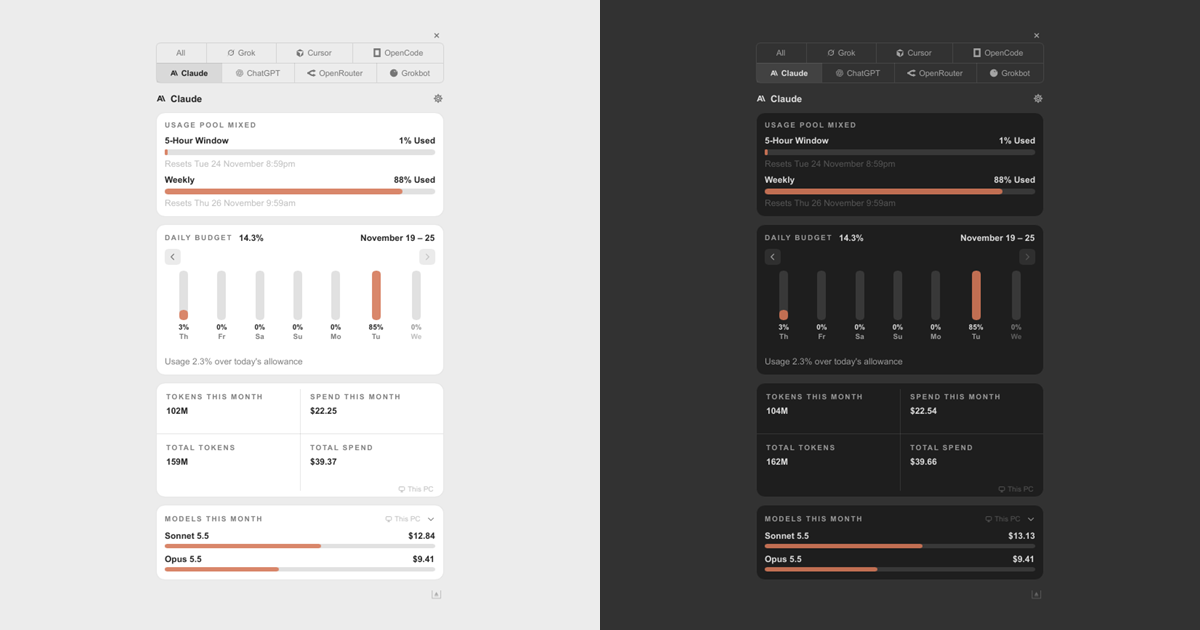
I keep a small menu bar app running all day that tells me how much of my AI allowances I’ve burned through: my Claude 5-hour session, my weekly pools, my Cursor billing cycle, my SuperGrok limits. It’s called TokenMon, and it started life as something much smaller, written by someone else.
It started as a Grok usage meter
On July 11, 2026, Austin Faulkner-Pearce made the first commit of a project called GrokUsage: “a macOS menu bar app for SuperGrok weekly usage tracking”. One provider, one number in the menu bar, a daily chart. It did one thing, and it did it well.
Then Austin shared it with family and friends, and that’s where it got interesting. People use different mixes of AI tools, and every service meters usage in its own way: rolling session windows, weekly pools, monthly billing cycles, credit balances, spending caps. The app grew a provider contract (session, usage client, poller, panel) so a new service is one folder and a registry entry. The Grok meter became a general one, and it became TokenMon. Today it tracks seven providers: ChatGPT (Codex), Claude, Cursor, Grokbot, OpenCode Go, OpenRouter and SuperGrok.
Then I joined
My first commit landed on August 6, a Makefile so the whole thing could be built, installed and released from the command line. Version 1.0.0 followed on August 19, and as I write this we’re at 1.13.2. If you want to look, it’s all open source: github.com/tokenmonitor/token_monitor.
TokenMon is a native Swift app for the Mac. I decided to port it to Windows, and I decided to port it to Rust.
Why Rust, and why only Rust now
That decision wasn’t about TokenMon. It came from DiarioBitcoin. Our tooling there had grown up in three languages at once: Java, Go and Python. I started moving it to Rust by hand, and the history of that work is still in the repository: the Rust folder’s history begins on October 1, 2022, when I moved my first Rust experiments into the main repository, and it has more than 1,700 commits touching it today. Everything that used to run on three different stacks became one language, and in the process it saved us two extra servers.
After that I stopped weighing languages. Every new project of mine is Rust, and TokenMon for Windows was going to be one too.
A port that can’t drift
The hard part of a port isn’t writing it, it’s keeping two apps behaving the same while both keep changing. So the Windows port is built around a rule: the Mac app’s tests are the specification. There’s a ledger that maps every one of the Mac app’s 924 tests to a Rust test. Right now 904 are ported, 19 are macOS-only by nature, and one is waiting on a decision. CI fails if a Swift test is added, renamed or deleted without the ledger being updated, and it fails if the Windows version number differs from the Mac one. Both apps ship the same version, 1.13.2.
The Windows app is a Rust workspace of 11 crates, around 93,000 lines including tests, with more than 2,000 automated tests. It lives in the system tray, draws its panels with Slint, follows Windows’ dark mode (or lets you pick), keeps your sign-ins encrypted with your Windows account through the Data Protection API, and updates itself. It installs from a per-user MSI with no admin rights, or runs from a portable zip. The macOS and Windows installers are built by composable GitHub Actions, unsigned for now, until we have the certificates to sign them.


TokenMon on Windows, in light and dark. It follows the Windows app mode, or you can pick a theme in Settings.
What’s next
The Windows port lives on the windows-port branch and is heading upstream so both apps can live in one repository. Signing, once I have the accounts, is the next piece. If you use more than one AI tool and you’d like to see where your limits stand without opening five tabs, give TokenMon a try, and a big thank you to Austin for starting it.

